Capabilities
Metal Stamping & Formed Metal Parts
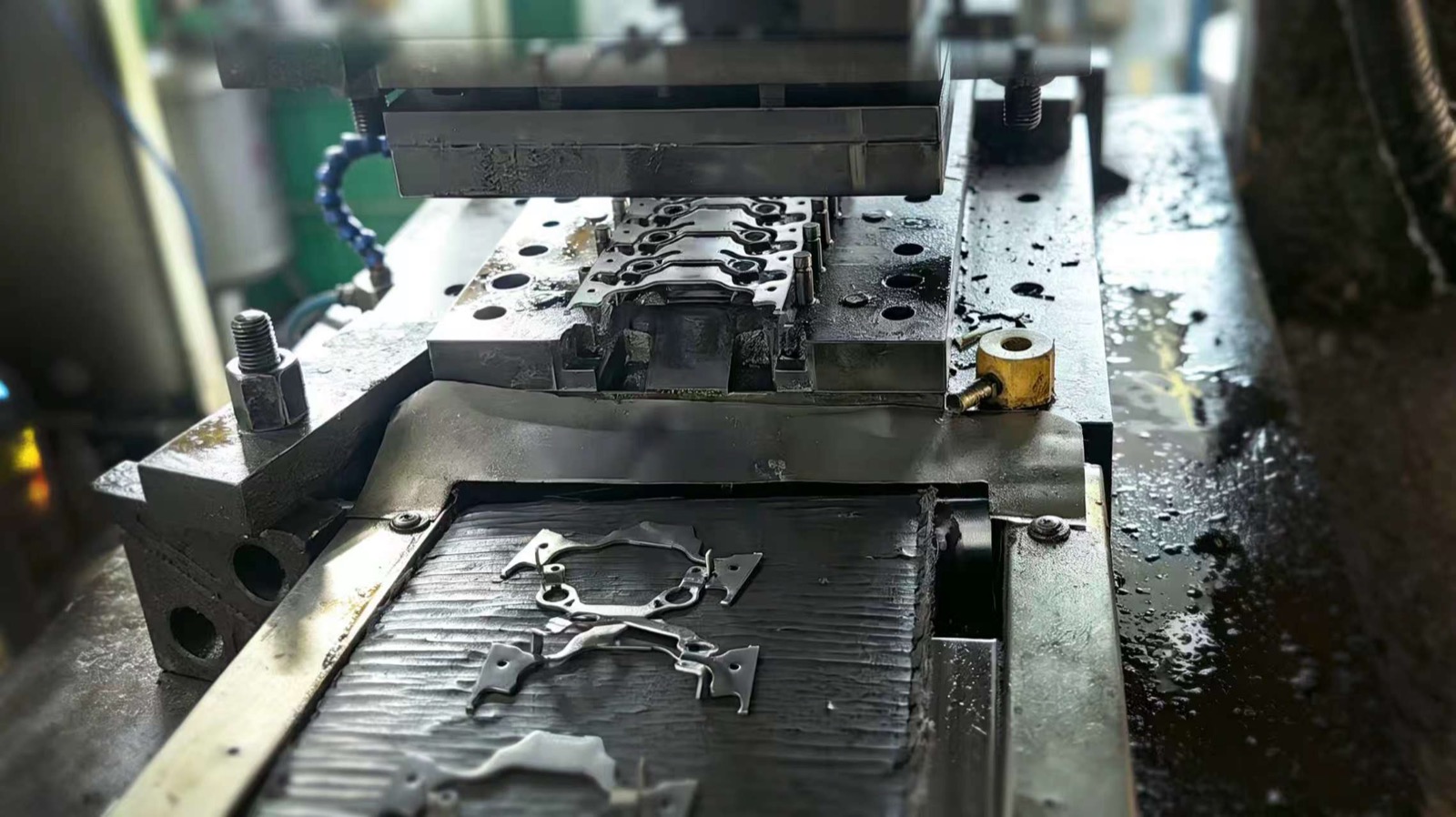
Fudakin runs metal stamping on the same Shenzhen floor as finishing and assembly, with tooling built to hold tolerance across a full production run.
Ask by Emailor copy tiger@fudakint.com1996
Manufacturing since
200,000
Square meters of floor
300+
People on the floor
30–45
Day production lead times
Harder Than It Looks
Tolerance
A flat blank, a few bends, a clean hole — simple once it's finished. Holding that shape, piece after piece, for the life of a run is what tooling and in-process checks are for.
Where It Fails
Where parts fail
Spring-back
Metal relaxes after the die releases it — unaccounted for, parts measure wrong on day one.
Die wear
Punches dull and clearances open over a long run. Parts drift without in-process checks.
Material behavior
Two coils of the same grade bend differently by temper and grain direction.
One Floor, Not One Vendor
Finishing
Progressive-die stamping runs higher volume off a continuous strip; single-hit fits simpler geometry or lower volume. Either way, formed parts move from the press into powder coating, painting, or plating, then assembly — no handoff to a second vendor.
Stamped parts often pair with other processes on the same program — a die-cast housing that mates to a bracket, or a laser-cut tube frameit attaches to. All of it runs under one roof, so the fit gets checked in-house.
FAQ
Frequently asked questions
What's the difference between progressive and single-hit stamping?
Single-hit stamping forms a part in one die stroke — good for simple shapes or low volume. Progressive stamping feeds a metal strip through a sequence of stations in one die set, with each station adding a cut, bend, or form, so a finished part comes off the end of the strip in one continuous run. Progressive tooling costs more up front but drops the per-part cost hard at volume.
What metals can be stamped, and does it matter which one?
Steel, stainless, and aluminum sheet are the common choices, and the metal matters for more than cost — thickness, temper, and grain direction all affect how a part springs back after forming, whether it cracks at a tight bend radius, and how consistent hole and edge quality are across a long run. We review material choice during DFM, before tooling is cut.
Why do stamped parts fail in the field even when the first samples looked fine?
Spring-back and die wear are the usual culprits. A formed part relaxes slightly after it leaves the die, and if that's not accounted for in the tool design, dimensions drift from the print. As a die wears over a production run, burrs and slight dimensional creep can show up gradually — parts that measured fine at first-article can drift out of spec thousands of pieces later without in-process checks.
Can a stamped part be finished and assembled in the same place it's formed?
Yes. Stamped brackets, housings, and formed metal parts made on our Shenzhen floor can move directly into finishing and assembly on the same site, so a metal part doesn't ship out to a second vendor for paint, plating, or fastening before it comes back for final assembly.
Is metal stamping a fit for low-volume or prototype runs?
It depends on the part and the tooling cost that makes sense for the volume — a simple bracket may be cut on a single-hit die cheaply even at modest volume, while a complex progressive-die part only pays for itself at higher volume. Send us the drawing and the expected quantity and we'll tell you honestly which approach fits.
Talk to us about a stamped metal part
Send the drawing, material, and expected volume — we'll tell you honestly whether single-hit or progressive tooling fits.