Capabilities
Aluminum & Zinc Die Casting
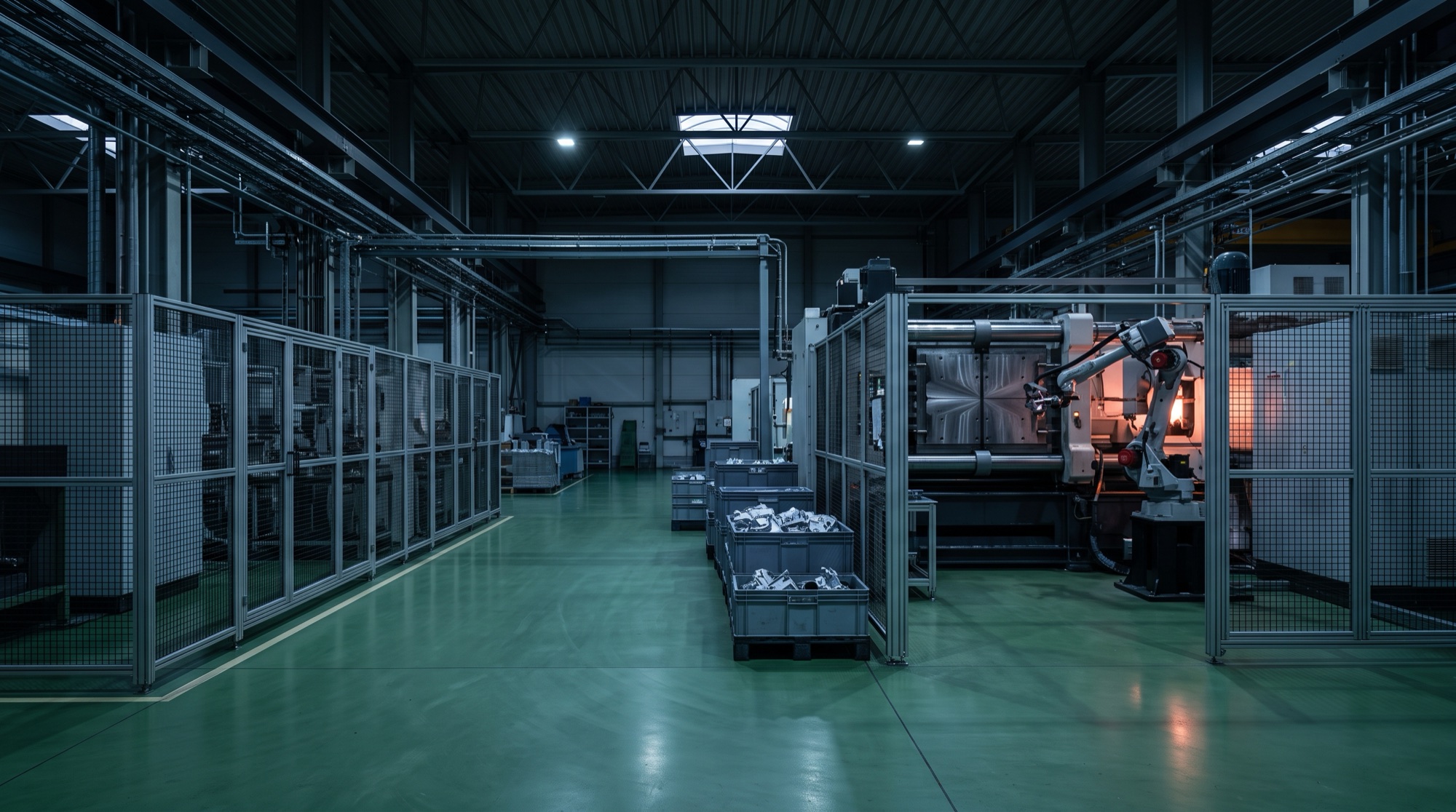
Fudakin runs die casting on the same Shenzhen floor as our machining and finishing lines, engineering the die so the metal fills and cools without trapping porosity.
Ask by Emailor copy tiger@fudakint.comWhat Fudakin runs
Fudakin runs aluminum and zinc die casting on the same Shenzhen floor as our CNC machining and finishing lines. A die-cast part comes off the press near its final shape, then moves straight to CNC finishing for any tight-tolerance surface, threaded hole, or mating feature that casting alone can't hit — checked against the ZEISS CMM lab we run in-house (see tolerance and inspection). From there it goes directly into powder coating, painting, or anodizing and plating, and on into final assembly, without a truck ride to another vendor in between.
We review alloy choice and die design together during DFM, before any tooling is cut — aluminum for lighter, stronger, heat-resistant parts, zinc for finer detail and thinner walls. That's where porosity and shrinkage problems get engineered out, not discovered on the floor after the tool is already built.
Cast components often work alongside stamped metalbrackets or a laser-cut tube frame in the same assembly — a die-cast housing bolted to a stamped bracket, for example. Because casting, machining, and finishing all run under one roof, that fit gets checked in-house instead of guessed at across vendors.
What to get right
A die-cast part looks like a simple metal shape once it's finished. What's invisible is whether the metal filled the die cleanly, cooled evenly, and released without trapping defects that only show up under load or after the part ships.
Porosity
Trapped air or gas inside a casting forms voids that don't always show on the surface. A part can look perfect and still fail a pressure test, crack under load, or leak where it's supposed to seal. Preventing it comes down to gate and vent design, controlled metal temperature, and a die engineered for how the specific alloy fills — decided before the tool is cut, not fixed after parts start failing.
Shrinkage and dimensional control
Metal contracts as it cools from molten to solid, and a die has to be cut oversized by the right amount to land on final dimensions. Get that wrong, or ignore how wall thickness changes cooling rate across the part, and the casting comes out warped or off-print in ways that only show up after the tool is already built.
FAQ
Frequently asked questions
What's the difference between aluminum and zinc die casting?
Aluminum die casting produces lighter, stronger parts with good heat resistance, and it's the common choice for structural housings and heat-sink-style components. Zinc casts at a lower temperature, holds finer detail and thinner walls, and machines and plates well — a common choice for smaller, more intricate parts. Which one fits depends on the part's strength, weight, and finish requirements, not on cost alone.
What does "near-net-shape" actually mean for a die-cast part?
It means the part comes out of the die very close to its final geometry, needing little or no machining to reach finished dimensions — unlike machining a part from solid stock, where most of the material is cut away. Near-net-shape is what makes die casting economical at volume: the die does most of the shaping work in one shot.
Where does die casting actually go wrong?
Porosity is the most common failure — trapped air or gas forms voids inside the casting that don't show up on the surface but weaken the part or leak under pressure. It comes from poor gate and vent design, inconsistent metal temperature, or a die that hasn't been engineered for the way the specific alloy fills and cools. Preventing it is a tooling and process discipline problem, not something fixed after the fact.
Can a die-cast part be machined and finished after casting?
Yes — die casting gets a part close to final shape, and any tight-tolerance surfaces, threaded holes, or mating features are CNC-finished afterward. From there the part can move into painting, powder coating, or plating on the same floor, so a cast housing doesn't need a second vendor to become a finished component.
Is die casting or CNC machining the right call for a metal housing?
Die casting wins at volume, once tooling is paid for, because near-net-shape parts come off the die fast and consistent. CNC machining wins for low volume or when a design changes often, since it needs no hard tooling at all. Many programs use both — die cast for the bulk shape, CNC for the surfaces that need it.
Talk to us about a metal housing
Send the drawing, alloy preference, and volume — we'll tell you honestly whether die casting or CNC fits your part.